


A post is being shared on social media (here, here, and here) with claims that the Bombay High Court has warned that the excuse of “not knowing Marathi” will not be accepted in Maharashtra. It alleges that anyone working in the state must know Marathi or learn it; otherwise, action will be taken under Article 345 of the Constitution, the Maharashtra Official Language Act, 1964, and IPC Section 166. Let’s verify the claim made in the post in this article.
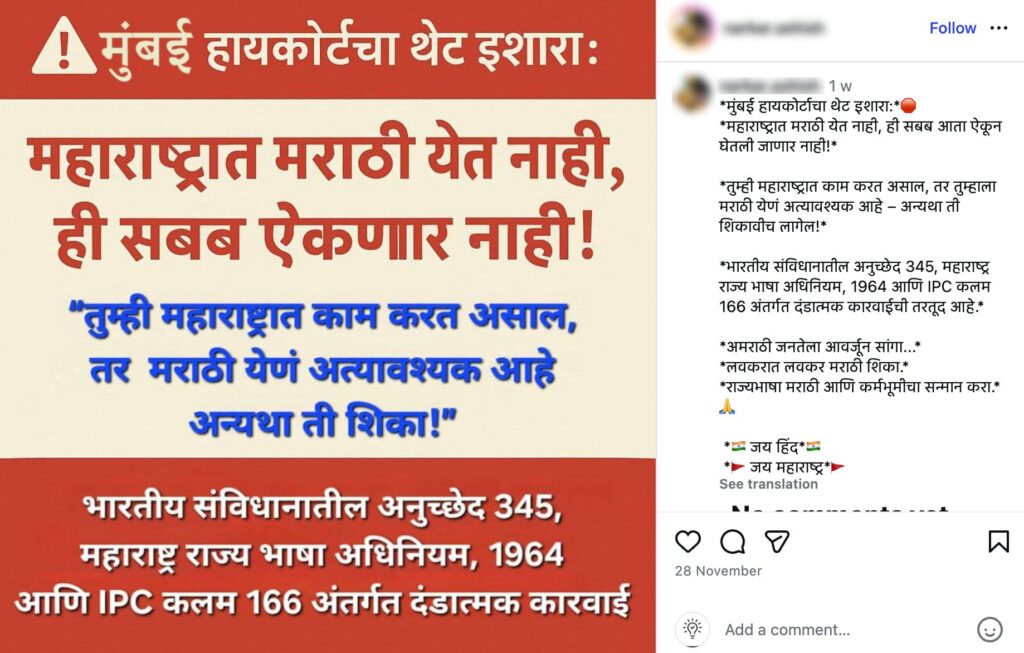
Claim: The Bombay High Court has ordered that people in Maharashtra must learn Marathi and cannot use “not knowing the language” as an excuse.
Fact: The Bombay High Court has not ordered that people in Maharashtra must learn Marathi and cannot use “not knowing the language” as an excuse. No credible news report or official record shows that such a directive was issued. In September 2019, petitioner Bhagwanji Raiyani argued he could not understand certain Marathi documents. The bench of Justice Satyaranjan Dharmadhikari and Justice Gautam Patel noted that if a litigant does not understand Marathi, it is time to learn it; however, this was a specific ruling applicable to that case, rather than a general order for all those in Maharashtra. Hence, the claim made in the post is FALSE.
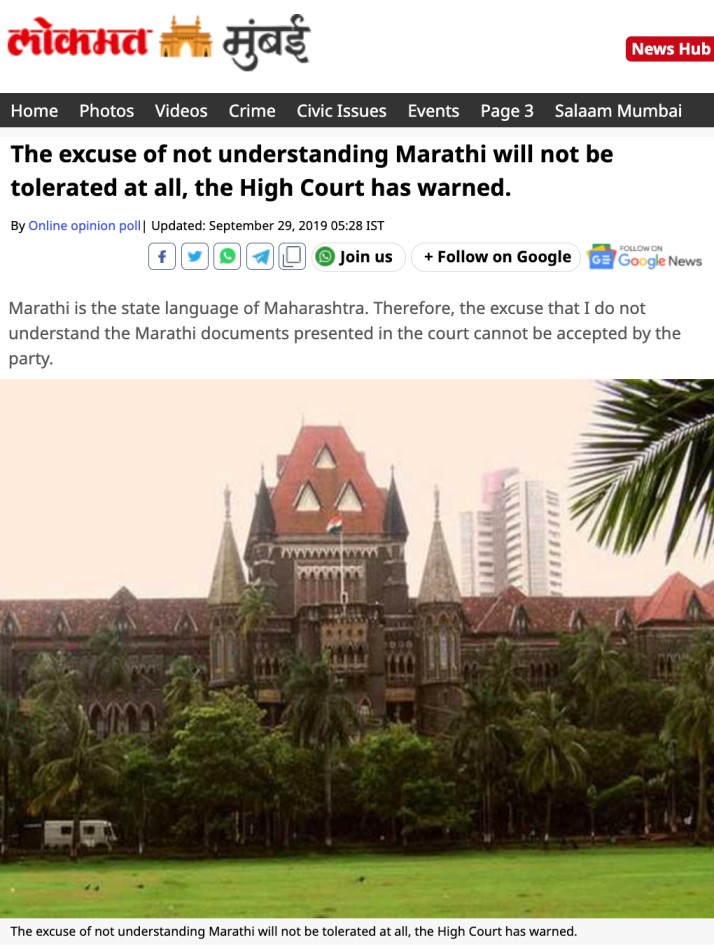
During research, we found a Lokmat news report dated 29 September 2019, with the headline (translated): “The excuse of not knowing Marathi will not be tolerated at all, the High Court has warned.” The report states that Bhagwanji Raiyani had built a four-building project in Gokhivare village under the Vasai Virar Municipal Corporation, which had refused to issue a residential certificate, leading Raiyani to file a petition. The municipality submitted a detailed affidavit explaining why the certificate could not be issued, accompanied by the municipal resolution and notices in Marathi. Raiyani argued that he did not understand Marathi and requested the court to quash the documents. The bench of Justice Satyaranjan Dharmadhikari and Justice Gautam Patel rejected this argument, stating that if he did not know Marathi, it was time to learn it, and that he could not make such statements about the state language. The petitioners had claimed the disclosure forms were “inapplicable” because they did not speak Marathi. Still, the court clarified that such a demand could not be accepted solely on this ground and questioned how the petitioners could claim the Marathi documents were inapplicable if they did not understand them. The court also told the petitioners that the official language of the state is Marathi, and if they do not understand it, it is their responsibility to learn it.
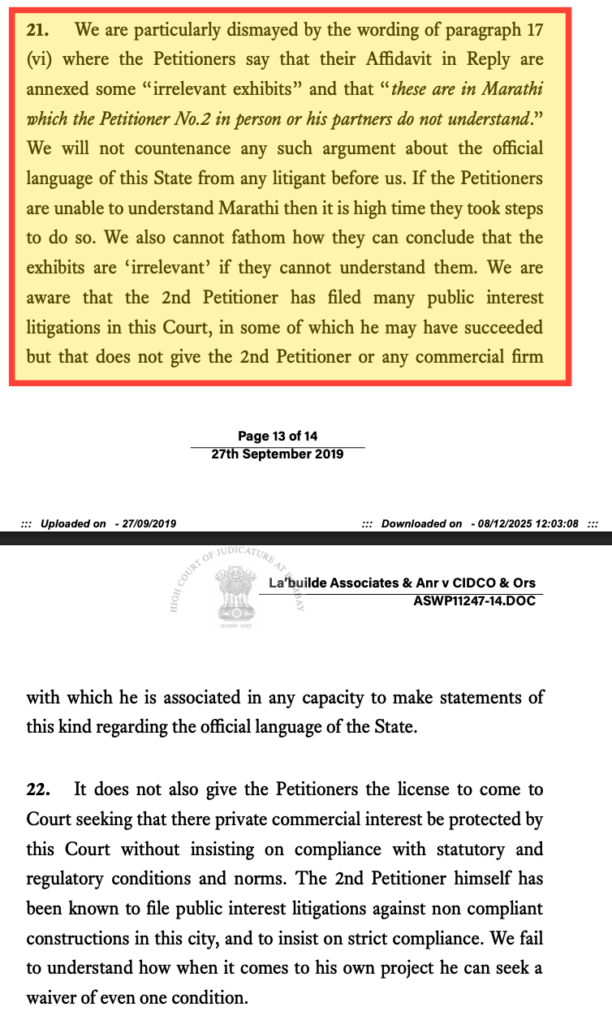
We also found the Bombay High Court’s September 2019 judgment on the petition between Vasai Virar Municipal Corporation, Development Authority, and La Build Associates. The judgment included entries related to the petitioner’s argument that the Marathi-language disclosures submitted in the case should be disregarded because they did not understand Marathi. This was not a directive to the entire State, but merely a remark made in the context of that specific case.
The viral post also cites Article 345 of the Constitution, the Maharashtra Official Language Act, 1964, and IPC Section 166 as grounds for taking legal action against those who do not know Marathi. However, Article 345 only allows a state to choose its official language and does not require citizens to learn it. The Maharashtra Official Language Act, 1964, declares Marathi as the state’s official language but does not prescribe any punishment for those unable to speak or understand it. IPC Section 166 applies to government officials who intentionally violate the law and has no relevance to ordinary citizens or their language skills. Therefore, these legal references do not support the viral claim.
To sum up, the viral post claiming that the Bombay High Court has ordered people in Maharashtra to learn Marathi or face action is fake.


