

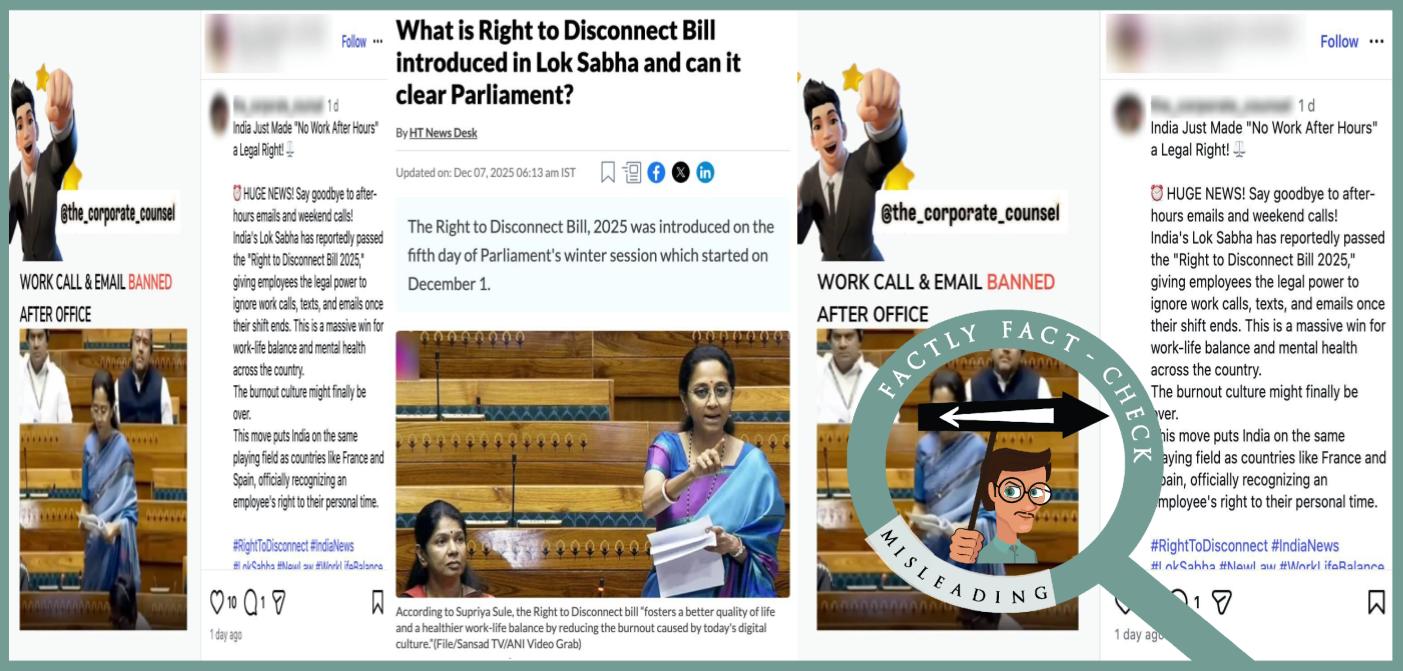
A viral social media post (here, here, and here) claims that the Lok Sabha has passed the Right to Disconnect Bill 2025, allegedly granting employees a legal right to ignore work-related calls and messages after office hours. Let’s verify the claim made in the post in this article.
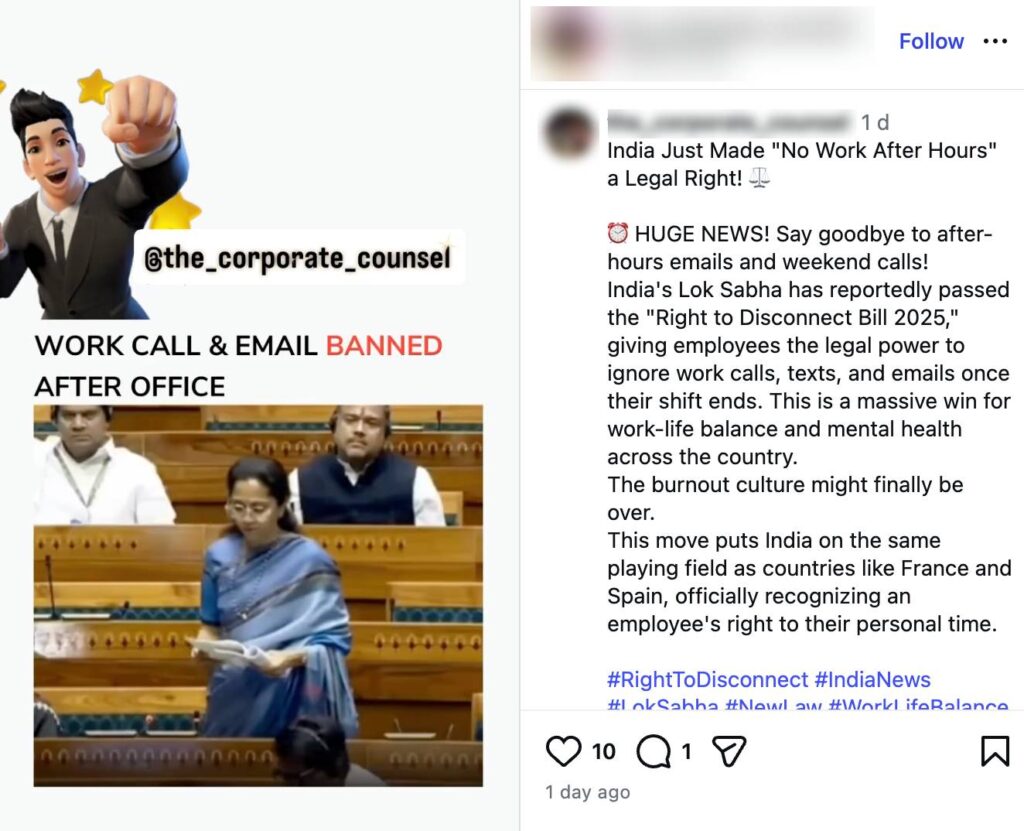
Claim: The Lok Sabha has passed the Right to Disconnect Bill 2025, granting employees the legal right to ignore work-related communication after office hours.
Fact: The Right to Disconnect Bill 2025 was introduced by NCP MP Supriya Sule on 05 December 2025. It is a Private Member’s Bill, not a government bill. At the time of writing this article, the bill is still pending and has not been passed. Similar bills introduced by the same MP in 2018 and 2021 had also lapsed. Since 1952, only 14 Private Members’ Bills have become laws, and the last one was passed in 1968. Hence, the claim made in the post is MISLEADING.
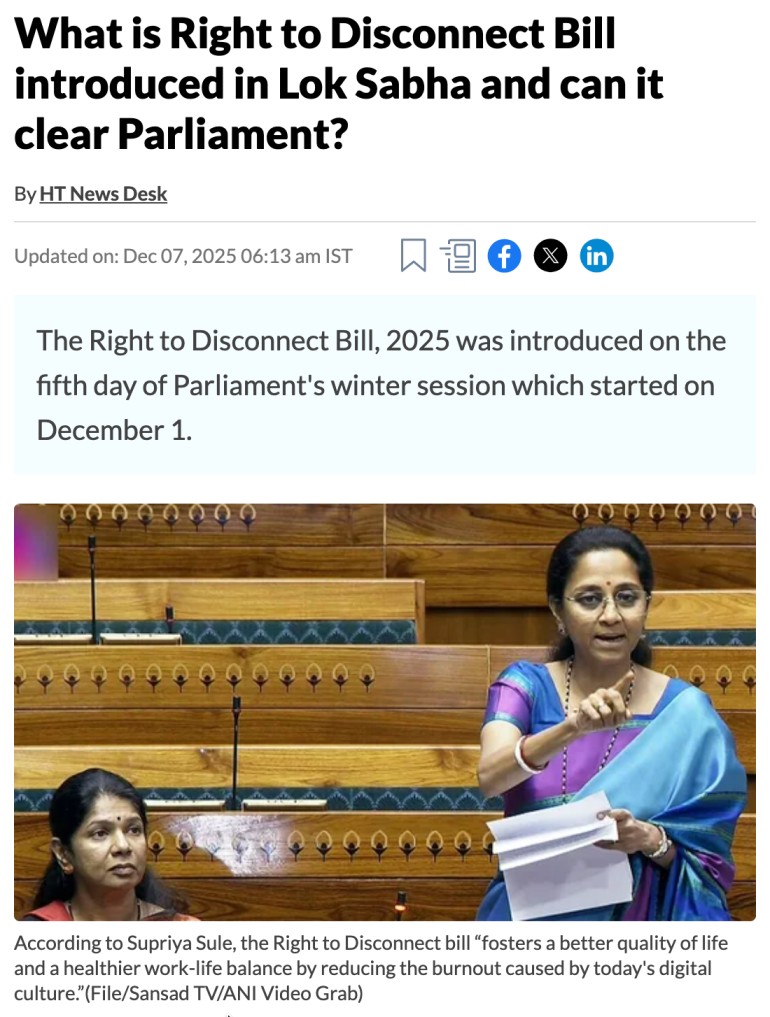
To verify the claim, we searched online using relevant keywords and found (here, here, and here) that NCP MP Supriya Sule had introduced the Right to Disconnect Bill on 05 December 2025. The bill proposes that employees should not be contacted for work-related matters beyond office hours, allowing them to switch off from calls, emails, and digital tasks after their shift ends. It aims to promote a healthier work–life balance and protect mental well-being by recognising the right to rest outside working hours. However, this is a private member’s bill, not a government bill, and it had not been passed at the time of writing this article.
What is a Private Member’s Bill?
A Private Member’s Bill is a bill introduced in Parliament by a Member of Parliament (MP) who is not a minister. Bills introduced in Parliament are categorised as Government Bills and Private Members’ Bills (here).
Key points about Private Members’ Bills:
- Any MP, whether from the ruling or opposition parties, can introduce it as long as they are not part of the Cabinet.
- Private Members’ Bills are usually discussed on Fridays.
- To become law, they must be passed by both Houses of Parliament.
- After approval from both Houses, the President’s assent is required for it to become an Act.
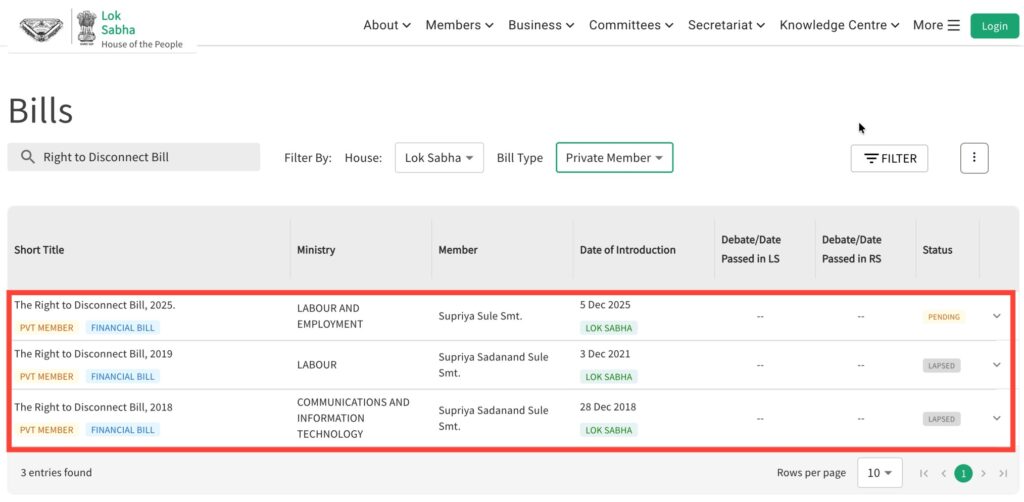
To check the status of the Right to Disconnect Bill 2025, we reviewed the Sansad website and found that the private bill introduced by NCP MP Supriya Sule on 05 December 2025 is still pending. Discussions on this bill have not yet taken place in Parliament. Therefore, contrary to the viral post claiming that the bill has been passed, it has not been passed.
We also found that similar private bills were introduced earlier by Supriya Sule, first on 28 December 2018 and then on 03 December 2021. Both these earlier bills lapsed as they were not passed during the respective parliamentary sessions.
Private Members’ Bills rarely become laws. The last Private Member’s Bill passed by Parliament was the Supreme Court (Extension of Criminal Appellate Jurisdiction) Bill, 1968, which became an Act on 09 August 1970. Since 1952, only 14 Private Members’ Bills have become laws.
To sum up, the Right to Disconnect Bill 2025 is a private bill that is still pending and has not been passed in the Lok Sabha.


