
In this edition of court judgments review, we look at the Calcutta HC ruling that a divorced daughter can receive a family pension if divorce proceedings were filed during the lifetime of the pensioner, Supreme Court’s order that Supreme Court: Bias cannot be assumed merely because a relative of a party works in a local police station or the district court, Karnataka HC’s order that neighbours or strangers cannot be implicated in matrimonial cruelty charges under section 498A, among others.
Calcutta HC: A divorced daughter can receive family pension if divorce proceedings were filed during the lifetime of the pensioner
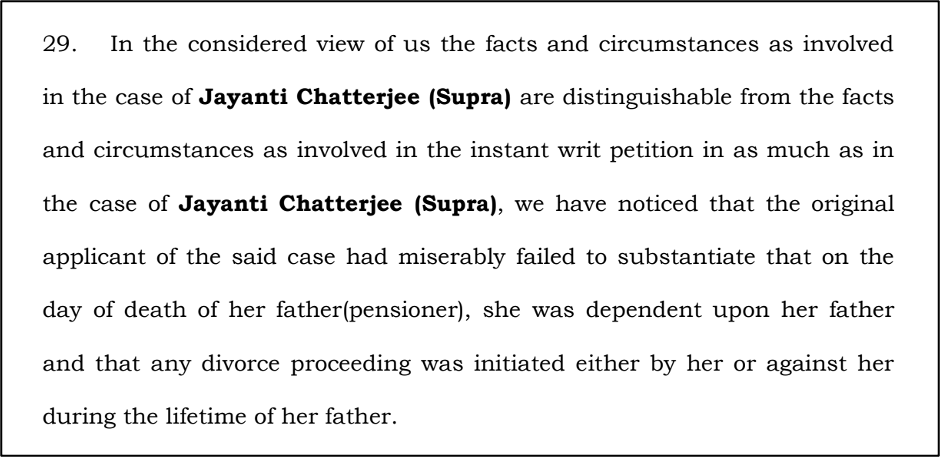
In Union of India vs. Mita Saha Karmakar, Mita sought her late father’s railway pension. Her father died in 2013, following her mother’s death in 2011. Married in 1991, Mita was abandoned in 1995 and returned to her father’s home for support. While her formal divorce was finalised in 2016 after her parents’ deaths, her husband had initiated a divorce suit in 1997 while her father was still alive.
The Union of India argued Mita was ineligible because the divorce decree was issued after her parents died. They claimed she applied too late and wasn’t dependent on her father at his death. Mita countered that she had lived with her father since 1997 with no income. She relied on government rules stating that if divorce proceedings begin during a pensioner’s lifetime, the daughter remains eligible for a pension.
The Calcutta High Court observed that family pensions aim to support dependent members and must be interpreted broadly. It noted that since a legal process for divorce existed while her father was alive, Mita met the statutory requirements. The Court emphasised that Mita was clearly dependent on her father due to her husband’s desertion and that technical delays should not deny support to vulnerable family members.
Ultimately, the Court dismissed the Union’s petition, upholding the order to grant Mita the pension. The judges confirmed that because the legal process started years before her father’s death and her dependency was proven, she was entitled to support. This verdict ensures that the law protects divorced daughters whose legal proceedings were active during their parents’ lifetimes, providing them a necessary means of survival.
Supreme Court: Bias cannot be assumed merely because a relative of a party works in a local police station or the district court
In the case, Prasanna Kasini vs. State of Telangana, the appellant (wife) challenged a High Court order that had transferred her criminal complaint against her husband from a court in Sangareddy to one in Hyderabad. The couple married in 2007 and lived in the USA before returning to India. A significant background issue involved a 2013 divorce decree obtained by the husband, which the wife claimed was done “surreptitiously” without her knowledge while they were attempting to reconcile. In 2022, after she was allegedly forced out of the marital home, she filed a criminal case in Sangareddy that became the subject of this transfer dispute.
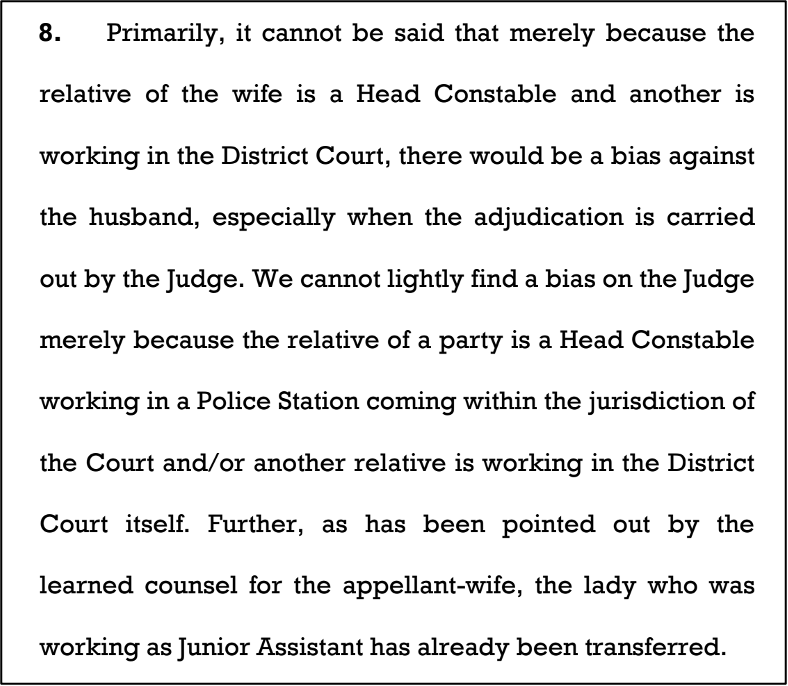
The wife argued that the transfer to Hyderabad was ordered without her being heard and caused her great hardship as she had to travel with two children. She highlighted the husband’s history of deceitful conduct regarding their legal status. The Husband contended that he could not get a fair trial in Sangareddy because the wife’s brother-in-law was a local Head Constable and her sister-in-law worked as a Senior Assistant in the Sangareddy District Court. He claimed these relatives used their influence to harass him and that he faced a threat to his life in that town.
The Supreme Court observed that the High Court had made the transfer order without properly hearing the wife’s side. The judges clarified that the mere presence of a party’s relative in the police force or court staff does not automatically mean a judge will be biased. They noted that the Junior Assistant relative had already been moved to a different court and that judicial decisions are made by judges, not administrative staff. The Court found the husband’s claims of bias to be “inconsequential” and noted that his past legal manoeuvres appeared to be an attempt to mislead his wife.
Ultimately, the Supreme Court allowed the appeal and set aside the transfer order. The Court directed that the case be sent back to the Additional Judicial Magistrate in Sangareddy immediately. If the case had been closed because the wife failed to appear in Hyderabad, the court ordered it to be restored and returned to Sangareddy. To address the husband’s safety concerns, the Court ruled that he could appear through his lawyer or via video conferencing, but the trial itself must proceed in the original court where the wife filed it.
Karnataka HC: Neighbours or strangers cannot be implicated in matrimonial cruelty charges under section 498A
In the case, Asha G vs. State of Karnataka & another, a neighbour was named as an accused in a criminal case filed by a wife against her husband and his family members. The wife alleged cruelty and harassment under Section 498A of the IPC and the Dowry Prohibition Act. Following an investigation, the police filed a charge sheet against the neighbour, Asha, claiming she had instigated the husband’s poor treatment of the wife. Asha subsequently approached the High Court seeking to have the proceedings against her cancelled.
The Petitioner contended that she was a stranger to the family and could not be prosecuted under Section 498A, which applies only to a husband or his “relatives.” She argued that her inclusion in the case was an abuse of the law and that she had no role in the couple’s matrimonial discord. Conversely, the State and the Complainant argued that the neighbour was the primary reason for the husband’s behaviour and should be required to face trial to clear her name.
The High Court observed that Section 498A is specifically designed to punish cruelty by a husband or a “relative” of the husband. Citing several Supreme Court precedents, the judge clarified that the legal term “relative” is strictly limited to blood relations or relations by marriage. Since Asha was simply a neighbour, she did not fall under this legal definition. The Court emphasised that dragging a stranger into such matrimonial proceedings constitutes an abuse of the legal process and the machinery of justice.
Ultimately, the Court allowed the petition and quashed the criminal proceedings against Asha G. The judge ruled that allowing the case to continue against a neighbour under Section 498A would result in a miscarriage of justice. This verdict reinforces that the law does not permit strangers or friends to be implicated in matrimonial cruelty charges intended solely for a husband and his family members.

Delhi HC: When a husband hides his financial details in maintenance case, courts must use minimum wages as a baseline
In the case of Arshi Parveen vs. Maqsood @ Sonu, the petitioner (wife) challenged an order that granted her only ₹2,500 per month as interim maintenance. Married in 2021, Arshi alleged that she was harassed for dowry and physically assaulted before being forcibly turned out of her matrimonial home in 2022. She is a housewife with an 11th-grade education and no independent income. While she claimed her husband was a graduate teacher earning around ₹70,000 monthly, the husband asserted he was a special educator earning only ₹10,000 per month.
The wife contended that the initial maintenance amount was insufficient to meet even her most basic needs. She argued that the husband was hiding his true income and that the court should have considered his qualifications and the prevailing minimum wages. The Husband argued that the wife was actually a nursery teacher capable of supporting herself and claimed he lived in a small, crowded house with eight family members, leaving him with limited funds after supporting his parents.
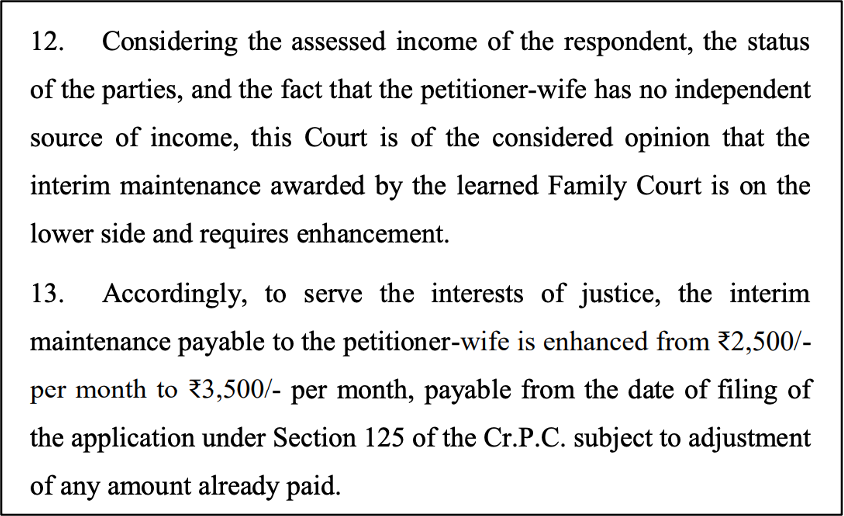
The High Court observed that the husband provided no proof that his wife was employed. Therefore, she was entitled to support. Regarding the husband’s earnings, the judge found his claimed income of ₹10,000 suspicious, as it was lower than the legal minimum wage for a graduate. The Court emphasised that when a husband hides his financial details, courts must use the minimum wage as a baseline. Since the husband works in Uttar Pradesh, the court applied that state’s minimum wage for a skilled graduate, which was approximately ₹13,200.
Ultimately, the High Court allowed the wife’s petition and increased the monthly support. The judge ruled that the husband’s education and status required a fairer contribution toward his wife’s sustenance. The Court enhanced the interim maintenance from ₹2,500 to ₹3,500 per month, effective from the date she first filed the case. The husband was ordered to clear all back payments within three months, ensuring the wife receives more appropriate financial assistance during the ongoing legal trial.
Calcutta HC: Using caste names like ‘adivasi’ or ‘santhal’ in public to humiliate a crime under the SC/ST Act
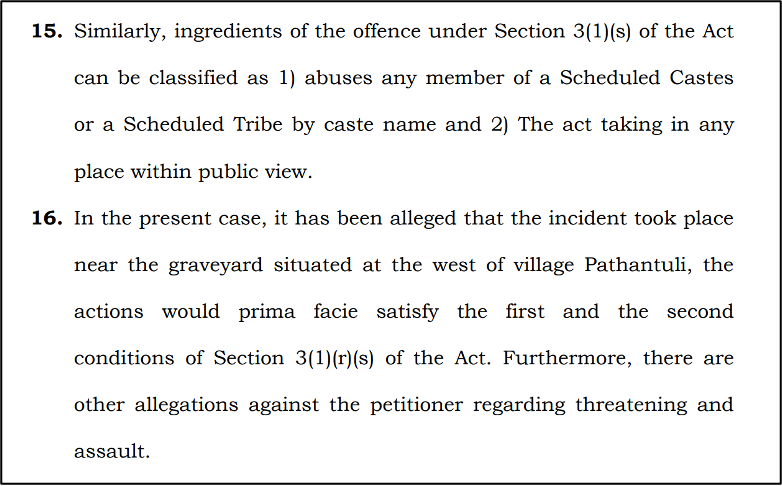
In the case of Suranjan Mandal vs. The State of West Bengal, the accused tried to cancel a criminal case involving assault and caste-based abuse. The victim alleged that in May 2022, near a village graveyard, the accused blocked his path, hit him, and insulted his identity. While initial charges included attempted murder, the final police report focused on wrongful restraint, assault, and crimes under the Scheduled Castes and Scheduled Tribes (Prevention of Atrocities) Act.
The petitioner argued the claims were fabricated due to a personal grudge and that the insults were not proven to be in “public view.” The State opposed this, presenting witness statements and the victim’s testimony. They argued the graveyard was a public spot and the evidence clearly pointed toward intentional humiliation and physical harm, establishing a solid reason to proceed with the case.
The Court observed that a village graveyard visible to others qualifies as a “place within public view.” Specifically, the Calcutta High Court held that abusing a person by calling them by their caste name, such as “Adivasi” or “Santhal”, in a place within public view, with the intent to humiliate, can amount to an offence under the Scheduled Castes and Scheduled Tribes (Prevention of Atrocities) Act, 1989. It refused to conduct a detailed inquiry into the truth of the claims at this early stage.
The High Court dismissed the petition, directing the accused to stand trial. The judge ruled that the allegations sufficiently satisfied the legal requirements for the charges. This decision emphasises that when there is basic evidence of caste-based abuse in a public space, a full trial is necessary to uncover the truth and ensure justice for the victim.