

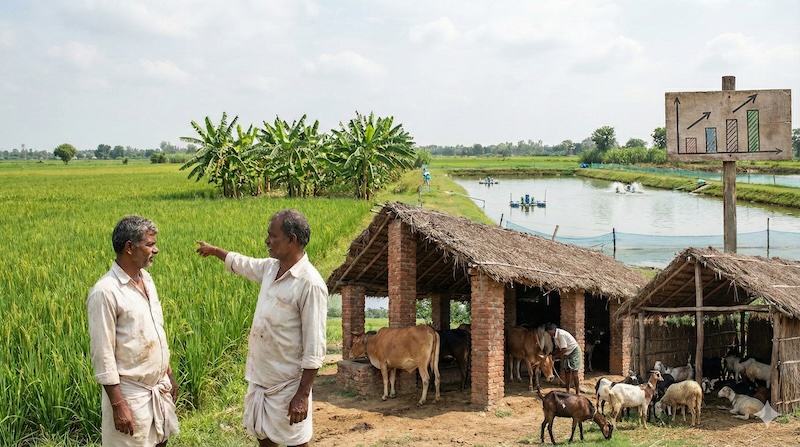
TL;DR: India’s agricultural output is steadily growing and diversifying. While crops still contribute the most, their share is shrinking as livestock and fisheries gain momentum. Cereals and fruits & vegetables dominate crop output, but high-value items like spices are rising. Livestock output has nearly doubled, driven by milk and fast-growing meat production.
Context:
The recently released report, Statistical Report on Value of Output from Agricultural and Allied Sectors, highlights India’s long-term growth in crops, livestock, fisheries and forestry. It shows rising output, evolving crop patterns and greater contributions from high-value segments like horticulture and aquaculture. This data captures how the sector has progressed over more than a decade, reflecting improvements in productivity, diversification and regional performance.
Who compiles this data?
The data on the value of output from agriculture and allied sectors is compiled by the National Accounts Division (NAD) of the Ministry of Statistics and Programme Implementation (MoSPI). The information is provided in a disaggregated manner, covering crops, livestock, forestry and logging, and fishing and aquaculture.
Where can I download clean & structured data about Agricultural and Allied Sectors output?
Clean, structured, and ready-to-use datasets on the value of output from agriculture and allied sectors can be downloaded from Dataful.
Key Insights
India’s Farm output is shifting over time, with crop sector declining
India’s agriculture and allied sectors have steadily expanded over the years. The total Gross Value Output (GVO), measured at constant prices (2011–12), has grown from ₹1,908 thousand crore in 2011–12 to ₹2,949 thousand crore in 2023–24, an increase of nearly 55%. Even though crops still make up the largest share, their contribution has gradually slipped from 62.4% to 54.1%. In contrast, livestock has nearly doubled in value, becoming one of the strongest performers. Forestry and logging show slow but steady progress, while fishing and aquaculture have expanded rapidly, rising from 4.2% to 7%. Altogether, the numbers point to a clear shift in India’s agricultural economy towards diversification.
Crop Output moving from Staples towards High-Value Produce
The latest data shows that India’s crop sector is gradually shifting focus. Cereals and fruits & vegetables still lead the way, making up around 52% of total crop output in 2023–24. Cereals remain the top contributor at ₹427.6 thousand crore, closely followed by fruits and vegetables at ₹410.0 thousand crore. Oilseeds stand third at ₹139.2 thousand crore.
One interesting trend is the steady rise of spices; their share has grown from 3.9% in 2011–12 to 5.9% in 2023–24, driven by strong market opportunities, especially for exports. Meanwhile, the shares of fibres, by-products, and even cereals have dipped slightly over the years.
Together, these changes suggest that farmers are increasingly moving beyond traditional staples and toward higher-value, nutrition-focused crops.
Livestock sector GVO rose by almost doubled between 2011-12 and 2023-24.
India’s livestock sector has expanded rapidly over the past decade, with its output value rising from ₹487.8 thousand crore to ₹919.3 thousand crore, a strong 88% growth between 2011-12 and 2023-24. Milk continues to dominate the sector, contributing about two-thirds of the total value, though its share is slowly easing as other products grow faster. Meat has shown the strongest surge, both in value and share, while eggs have seen steady but moderate gains. Meanwhile, wool and similar products are declining in economic relevance. Overall, livestock is emerging as a powerful driver of agricultural growth, even outperforming several crop segments.
Why does it matter?
A healthy agriculture sector helps ensure food availability at stable prices, reduces the risk of shortages. Increased output and diversification from allied sectors such as livestock and horticulture signal potential for jobs beyond traditional crop farming. However, while the output growth is impressive, this growth should translate into better income, livelihoods, and reduced inequalities among small, marginal and large farmers.
Key Numbers
- Sectoral Proportion in the total GVO of agriculture and allied sectors
2011-12: Crops- 62.4%, Livestock- 25.6%, Fishing & aquaculture- 4.2%
2023-24: Crops- 54.1%, Livestock- 31.2%, Fishing & aquaculture- 7.0%
- Sectoral Proportion of crop categories in the total GVO of Crop sectors
2011-12: Cereals- 28.2%, Fruits & Vegetables- 22.7%, Oilseeds- 9%
2023-24: Cereals- 26.8%, Fruits & Vegetables- 25.7%, Oilseeds- 8.7%
- Sectoral Proportion of Livestock categories in the total GVO in the total Livestock
2011-12: Milk Group- 67%, Meat Group- 20%
2023-24: Milk Group- 66%, Meat Group- 24%
Note: Featured image generated using Gemini Nano


