Review: Supreme Court says, ‘No Automatic Preference for Work-From-Home Parent in Child Custody’
In this edition of Court Judgements, we look at the Supreme Court’s judgement that the ICC at aggrieved woman’s workplace can hear posh complaint against officer from another department, that a demand of gold at childbirth ceremony not dowry, that there is no automatic preference for work-from-home parent in child custody, among others.
Supreme Court: ICC at Aggrieved Woman’s Workplace Can Hear POSH Complaint Against Officer from Another Department
In Dr. Sohail Malik vs. Union of India & Anr., the Supreme Court held that an Internal Complaints Committee (ICC) constituted at the workplace of an aggrieved woman has the jurisdiction to inquire into a sexual harassment complaint under the POSH Act even if the accused employee belongs to a different government department.
The case arose after a senior IAS officer alleged sexual harassment by an IRS officer at her workplace in New Delhi. Along with a criminal complaint, she approached the ICC of her own department. The appellant challenged the ICC’s authority, arguing that only the ICC of his parent department could conduct the inquiry since disciplinary action could be initiated only by his employer.
The Central Administrative Tribunal rejected this objection, and the Delhi High Court upheld that view. The matter was then taken to the Supreme Court.
Examining the scheme of the Sexual Harassment of Women at Workplace Act, 2013, the Court noted that the Act gives a broad meaning to “workplace”, covering any place visited in the course of employment. It clarified that the phrase “where the respondent is an employee” in Section 11 relates to the procedure to be followed after the inquiry and does not restrict the ICC’s jurisdiction.
The Court held that the ICC at the aggrieved woman’s workplace can conduct a fact-finding inquiry and forward its report to the employer of the accused officer, who may then take disciplinary action under applicable service rules. Finding no prejudice caused to the appellant, the Supreme Court dismissed the appeal.


Supreme Court: Demand of Gold at Childbirth Ceremony Not Dowry; Dowry Death Conviction Set Aside
In Baboo Khan vs. State of Rajasthan, the Supreme Court partly allowed an appeal against convictions under Sections 498A and 304B of the Indian Penal Code, holding that a demand made at a post-birth ceremony cannot be treated as a dowry demand.
The appellant married the deceased in 1986, and a male child was born in 1988. After a customary ceremony known as chhoochhak, the deceased and the infant were found dead in a well in November 1988. The deceased’s father alleged that she was harassed over demands for a gold ring and chain, leading to the appellant’s conviction for cruelty and dowry death by the Sessions Court, which was later upheld by the Rajasthan High Court.
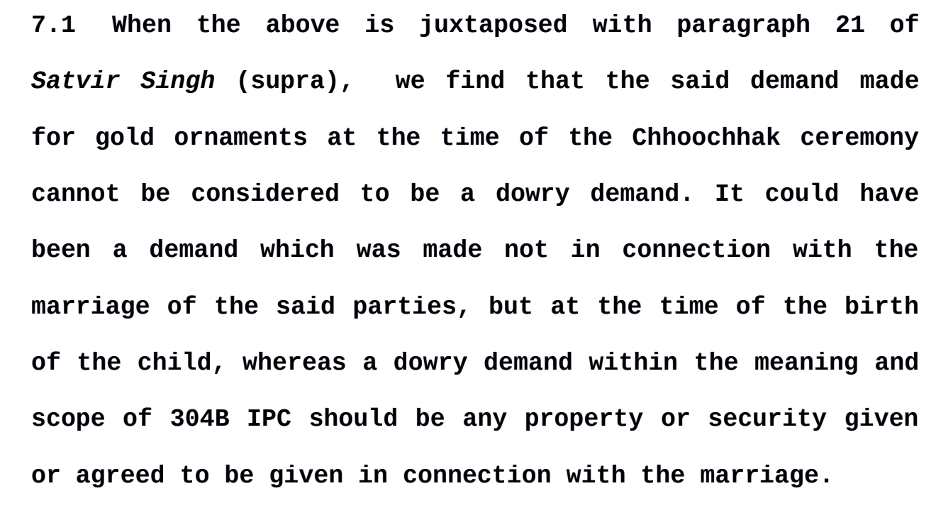
Before the Supreme Court, the appellant argued that the alleged demand was made during the childbirth ceremony and not in connection with the marriage. Relying on Satvir Singh vs. State of Punjab, the Court agreed, reiterating that for Section 304B IPC to apply, the demand must be directly linked to the marriage.
Since the demand arose after the marriage and at the time of childbirth, the Court held that the offence of dowry death was not made out and set aside the conviction under Section 304B IPC. However, it upheld the conviction under Section 498A IPC, finding sufficient evidence of cruelty. As the appellant had already undergone more imprisonment than the one-year sentence imposed, no further incarceration was required. The appeal was allowed in part.

Supreme Court: No Automatic Preference for Work-From-Home Parent in Child Custody
In Poonam Wadhwa vs. Ajay Wadhwa & Ors., the Supreme Court declined to interfere with the Punjab and Haryana High Court’s order granting interim custody of the minor son, Arjun, to his father, while continuing visitation rights for the mother.
The dispute arose after the High Court set aside lower court orders that had granted custody of Arjun to the mother. At the time of the lower court’s decision, Arjun was below five years of age, but he crossed that age during the High Court proceedings. The High Court held that final custody should be decided by the Family Court under the relevant statutes.
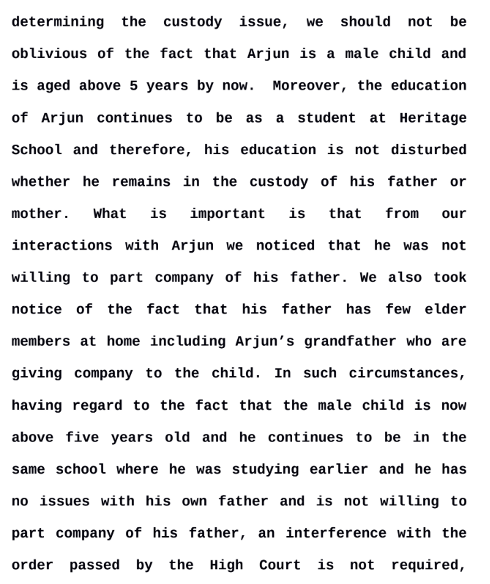
Before the Supreme Court, mediation efforts failed. The Court interacted with both parents and children and noted that both parents were working professionals and financially independent. It rejected the view that a parent working from home is automatically better suited for custody and held that factors such as distance to school or the mother’s travel during the COVID-19 period were not decisive.
However, the Court placed significant weight on the child’s present comfort and preference. Arjun, now over five years old, expressed unwillingness to part from his father. He was continuing in the same school and had the support of extended family at his father’s home.
In these circumstances, the Court found no reason to interfere with the High Court’s order. It clarified that the custody issue remains open for final adjudication and affirmed the mother’s visitation rights. The appeal was dismissed.

Supreme Court: Police Can Freeze Bank Accounts Under CrPC Even in Corruption Cases
In State of West Bengal vs. Anil Kumar Dey, the Supreme Court examined whether the police can freeze bank accounts under Section 102 of the Criminal Procedure Code when proceedings are initiated only under the Prevention of Corruption Act, 1988.
The case arose from a disproportionate assets investigation against a police officer. During the probe, fixed deposit accounts held in the name of his elderly father were frozen under Section 102 CrPC. While the trial court refused to de-freeze the accounts, the Calcutta High Court set aside the freezing, holding that attachment in corruption cases must follow Section 18A of the PC Act, read with the Criminal Law Amendment Ordinance, 1944.
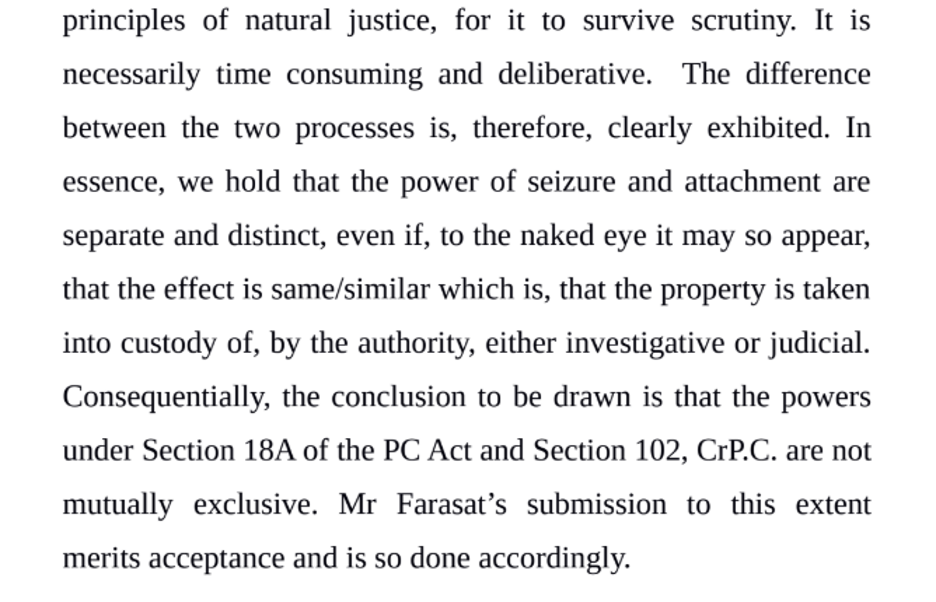
Allowing the State’s appeal, the Supreme Court explained the legal distinction between “seizure” and “attachment”. It held that a seizure under Section 102 CrPC is a temporary investigative step to secure suspected property, whereas an attachment under Section 18A is a separate judicial process involving notice and hearing. The two powers operate in different fields and are not mutually exclusive.
The Court clarified that the PC Act is not a complete code excluding the CrPC, and that the police were justified in freezing the accounts during investigation. Since the investigation was complete, it directed that if the amounts had already been released, the respondent must redeposit the money or furnish a bank guarantee within three weeks. The appeal was allowed accordingly.

Supreme Court: Money and Gold Given at Marriage Must Be Returned After Divorce
In Rousanara Begum vs. S.K. Salahuddin @ SK Salauddin & Anr., the Supreme Court considered whether money and gold given at the time of marriage by a woman’s father must be returned to her after divorce.
The appellant married the first respondent in August 2005. Following marital disputes, she left the matrimonial home in May 2009 and initiated proceedings under Section 125 CrPC and Section 498A IPC. The marriage was dissolved by divorce in December 2011. Thereafter, she approached the Magistrate under Section 3 of the Muslim Women (Protection of Rights on Divorce) Act, 1986, seeking return of mehr, cash, gold ornaments and other articles.
While the Magistrate and Sessions Court largely accepted her claim, the Calcutta High Court reversed those findings, relying on a statement made by her father in separate criminal proceedings that the money and gold were given to the husband.
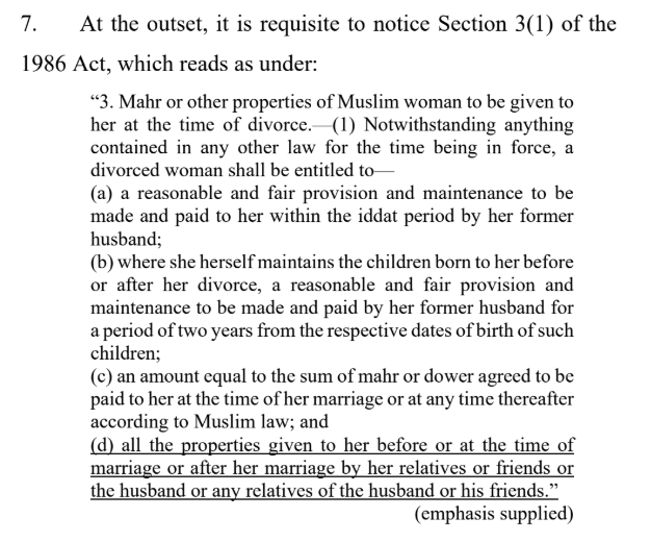
The Supreme Court disagreed, holding that Section 3 of the 1986 Act clearly entitles a divorced Muslim woman to receive mehr and all properties given to her before, at, or after marriage. It found that the High Court failed to properly consider the evidence of the marriage registrar and did not interpret the law in a manner that safeguards the dignity and financial security of divorced women.
Allowing the appeal, the Supreme Court set aside the High Court’s judgment and directed the respondent to return the money and gold to the appellant, failing which interest would be payable.