Review: SC Rules That Courts Must Fully Determine Who is Responsible for Marital Breakdown Before Dissolving It
In this edition of the court judgments review, we examine the Supreme Court’s ruling that Physical intimacy in a long-term, functioning relationship cannot be later branded as rape just because the relationship failed to lead to marriage, the court’s decision that courts must fully determine who is responsible for the marital breakdown before dissolving it, among others.
J&K and Ladakh HC: Every citizen has a fundamental right to a passport and travel, and does not need to prove a “pressing need” to travel
In the case, Zahoor Ahmad Pahalwan vs. UT of J&K, the petitioner is involved in a major criminal case. He previously received a one-year “No Objection Certificate” (NOC) pass from the court to get a temporary passport for a pilgrimage. As that passport was nearing its expiry date, he asked the trial court for a new NOC that would allow him to get a regular five-year passport. The trial court refused his request.
The Petitioner challenged the refusal in the High Court, arguing that he has a basic right as a citizen to hold a valid passport. The trial court’s refusal was based on two points- firstly, it said the application was too early because the old passport was still valid for a few months, and secondly, the petitioner failed to show documentation proving he had a necessary reason to travel abroad.
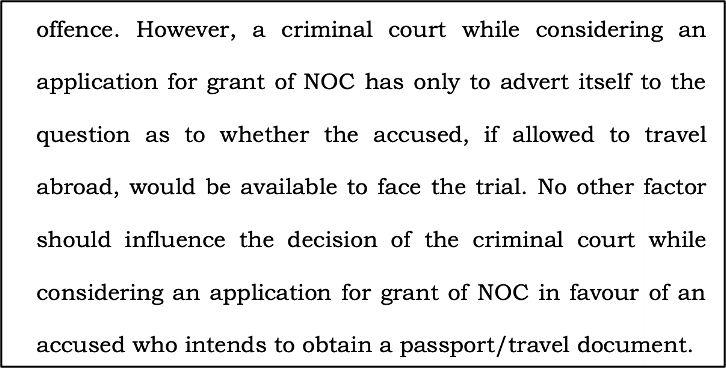
The High Court stated clearly that the trial court’s reasons were legally incorrect. The Court emphasised that every citizen has a fundamental right to a passport and travel, and they do not need to prove a “pressing need” or show business documents to get one. Citing an earlier Supreme Court ruling, the Court ruled that the only thing a criminal court should check is whether the person, if allowed to travel, is likely to return home to face the ongoing trial.
The High Court agreed with the petitioner and cancelled the trial court’s order. The case was remanded to the Special Judge with instructions to review the application again. The lower court must now grant the passport NOC unless it finds a strong reason to believe the accused will fail to return for his criminal trial.

SC: Physical intimacy in a long-term, functioning relationship cannot be later branded as rape just because the relationship failed to lead to marriage
The Appellant in the case, Samadhan vs. State of Maharashtra and another, is a practising advocate. He appealed against a Bombay High Court order that refused to quash the criminal proceedings against him. The proceedings stemmed from an FIR filed by a married woman who was separated from her husband. She accused Samadhan of establishing sexual relations with her multiple times over three years under the false promise of marriage. The relationship led to three pregnancies, all of which were terminated. The FIR was lodged only in August 2024 after the Appellant refused to marry her and allegedly threatened her.
The Appellant contended he was falsely implicated, arguing that the relationship was consensual and lasted three years without any complaint from the woman. He alleged the complaint was filed only after he refused the woman’s demand for money. The High Court had refused to quash the criminal charges, arguing that the claims had to be proven in a full trial because the relationship involved trust.
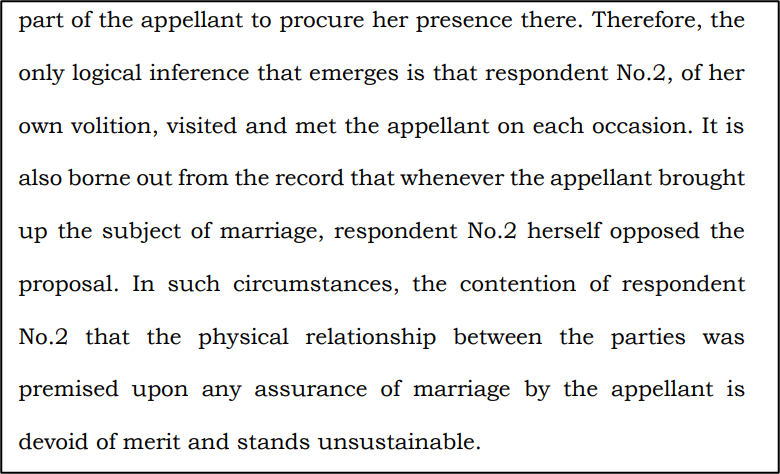
The Supreme Court closely examined the record and found the case to be a “classic instance of a consensual relationship having subsequently turned acrimonious.” The Court noted the woman was educated, already married, met the man willingly, and never complained during the three-year period. Crucially, the Court held that physical intimacy in a long-term, functioning relationship cannot be later branded as rape just because the relationship failed to lead to marriage. It emphasised that a false promise must be made from the very beginning with the intention to deceive to vitiate consent.
The Supreme Court allowed the appeal and set aside the High Court’s order. Consequently, the Court quashed the FIR and the chargesheet against Samadhan under Sections 376 (Rape), 376(2)(n) (Repeated Rape), and 507 (Criminal Intimidation) of the Indian Penal Code, ruling that continuing the prosecution would be an abuse of the court machinery.

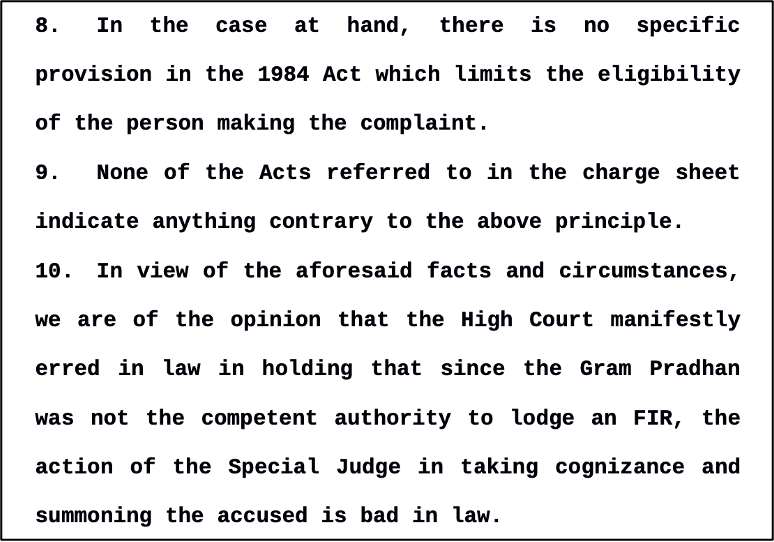
SC: Anyone can file complaint under the Prevention of Damage to Public Property Act, 1984
The case, Lal Chandra Ram vs. State of UP & others, started when the Gram Pradhan lodged a police complaint regarding an incident that included criminal mischief with public property under the Prevention of Damage to Public Property Act, 1984, assault, criminal intimidation, and offences under the SC/ST Act. Following the investigation, a chargesheet was filed, and the Special Judge directed the accused (respondents in the appeal) to appear in court. The accused challenged this order in the High Court.
The respondents in this appeal successfully argued before the High Court that the Gram Pradhan did not have the authority to file the FIR. They claimed that under the U.P. Revenue Code, 2006, only specific authorities like the Lekhpal or the Bhumi Prabandhak Samiti could take action related to public property damage, not the Gram Pradhan. The appellant (Lal Chandra Ram) challenged the High Court’s ruling in the Supreme Court.
The Supreme Court held that the High Court made a clear legal error. The Court explained that the U.P. Revenue Code provisions cited by the High Court are meant for civil issues like assessing damages or evicting trespassers. However, to start a criminal case for damage to public property, the 1984 Act applies. The Court emphasised that any citizen could set the criminal law in motion by filing a complaint, unless the specific law creating the offence says otherwise. Since the 1984 Act does not restrict who can file a complaint, the Gram Pradhan was legally entitled to lodge the FIR.
The Supreme Court set aside the High Court’s order from September 2024 and allowed the appeal.

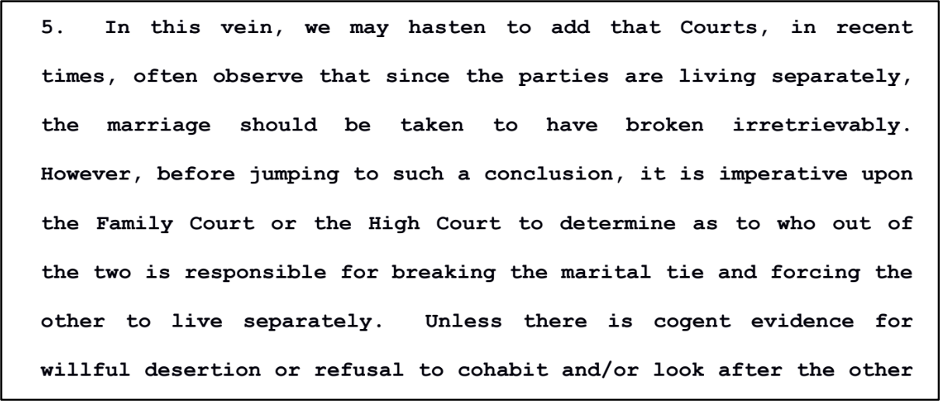
SC: Courts must fully determine who is responsible for the marital breakdown before dissolving it
In the case, Dr. Anita vs. Indresh Gopal Kohli, the husband and wife married in 2009. After the husband withdrew his first divorce petition, he filed a second one in 2013 based on desertion. The trial court rejected this petition. However, the High Court reversed the trial court’s decision, granting the husband a decree of divorce on the grounds of cruelty. The wife then challenged this judgment before the Supreme Court.
The wife argued that the High Court had failed in its basic duty to investigate the facts, specifically ignoring her claim that the husband had forced her out of the matrimonial home. She contended that the High Court should have determined which spouse was truly responsible for the failure of the marriage. The husband, conversely, supported the High Court’s ruling, which had accepted his verbal claims regarding the mental cruelty he allegedly suffered.
The Supreme Court criticised the High Court for granting a divorce based merely on the husband’s narrative without deeply analysing all the evidence, including the wife’s claim of being wrongly forced to leave. The Court stated that before concluding that a marriage is irretrievably broken and dissolving it, courts must fully determine who is responsible for the marital breakdown, as failing to do so can result in an unjust decision and potentially harm the child.
Ultimately, the Supreme Court allowed the appeal in part and set aside the High Court’s judgment. The entire matter was then remitted to the High Court with directions to conduct a fresh review and issue a new decision based on a complete and thorough analysis of all the facts and circumstances of the case.