Review: Bombay HC Rules That Preventing Feeding of Stray Dogs Near School Bus Stops Not a Criminal Offence
In this edition of court judgments review, we look at the SC’s order where it held that body-shaming after childbirth does not amount to ‘cruelty’ under Section 498A IPC, that vacancy arising after resignation must follow communal rotation, not rank list order, Bombay HC’s order that preventing feeding of stray dogs near school bus stops is not a criminal offence, among others.
Supreme Court: Body-shaming after childbirth does not amount to ‘cruelty’ under Section 498A IPC
In Belide Swagath Kumar vs. State of Telangana & Anr., the Supreme Court has quashed criminal proceedings against a husband under Section 498A of the IPC and Sections 3 and 4 of the Dowry Prohibition Act, holding that the allegations reflected ordinary marital discord and did not meet the legal threshold of cruelty or dowry harassment.
The case arose from a matrimonial dispute between two software engineers working in the United States, who married in December 2016 and later had a child. Following marital differences, the wife returned to India with the child in August 2019. In January 2022, after the husband issued a legal notice seeking restitution of conjugal rights, the wife lodged an FIR alleging cruelty, dowry demands, financial control, lack of emotional support during pregnancy, and body-shaming after childbirth.
A chargesheet was filed against the husband and his family members. While the Telangana High Court quashed proceedings against the husband’s parents and relatives, it refused to interfere with the case against the husband, prompting the appeal.
Allowing the appeal, the Supreme Court held that the allegations in the FIR were vague and general, lacking specific dates, incidents, or particulars. The Court observed that claims such as maintaining household expense records, sending money to parents, emotional neglect, or body-shaming, even if assumed to be true, did not constitute “cruelty” under Section 498A IPC.
The Court reiterated that criminal law cannot be used to criminalise routine marital disagreements or the wear and tear of married life. It found no material indicating coercive dowry demands or conduct causing grave mental or physical harm. Relying on established precedent, including State of Haryana vs. Bhajan Lal, the Court held that continuation of the proceedings would amount to abuse of process.
Accordingly, the FIR and all consequential proceedings were quashed, with the clarification that the ruling would not affect any pending civil or matrimonial disputes.


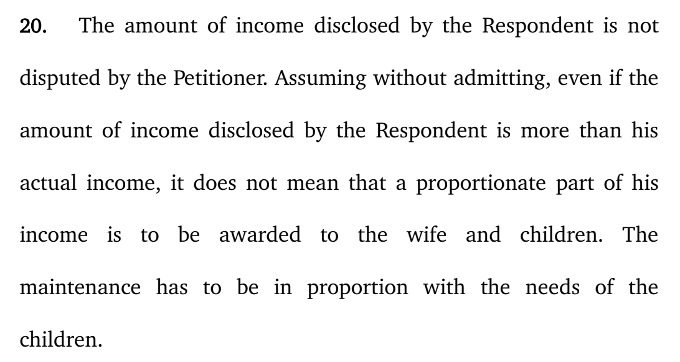
Bombay HC: A husband earning a lot doesn’t automatically mean his wife and kids get a proportional chunk of his salary as maintenance
The Bombay High Court has partly allowed a writ petition filed by a wife seeking enhancement and clarification of interim maintenance, holding that maintenance awarded to minor children must be read individually and that interim maintenance should ordinarily be payable from the date of application.
The dispute arose from matrimonial proceedings between a couple married in 2014, who have two minor daughters. During the pendency of the husband’s divorce petition, the wife sought interim maintenance under Section 24 of the Hindu Marriage Act. In August 2023, the Family Court directed the husband to pay ₹50,000 per month to the wife and ₹50,000 per month to the two daughters collectively, from the date of the order.
Challenging this, the wife sought higher maintenance, clarity on whether the amount was payable per child, and payment from the date of her application.
The High Court noted that the husband’s disclosed monthly income was nearly ₹4 lakh, while the wife was a homemaker with no independent income and bore primary responsibility for the children. Although the Court rejected the wife’s claim for ₹3.5 lakh per month as excessive, it found that ₹50,000 collectively for both daughters was inadequate given their standard of living and educational needs.
Interpreting the operative portion of the Family Court’s order, the High Court held that the term “each” must be read to mean ₹50,000 per month payable separately to the wife and to each daughter. It further held that awarding maintenance from the date of the order, rather than from the date of application, was contrary to settled law laid down in Rajnesh vs. Neha.
Accordingly, the High Court modified the order and directed payment of ₹50,000 per month to the wife and to each daughter from the date of application, after adjusting amounts already paid under the interim consent terms.

Supreme Court: Vacancy arising after resignation must follow communal rotation, not rank list order
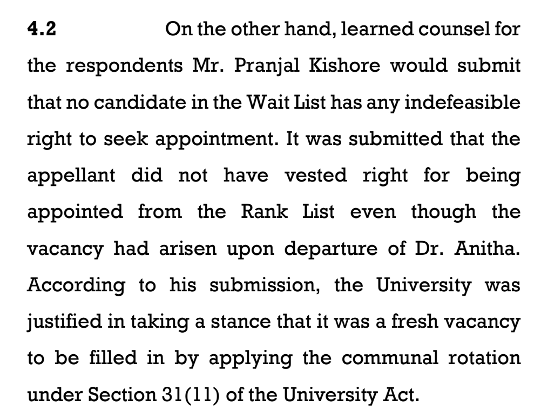
In Radhika T. vs. Cochin University of Science and Technology, the Supreme Court has held that the validity of a rank list does not override statutory communal reservation rotation, and that a wait-listed candidate has no automatic right to appointment when a vacancy arises due to resignation.
The case concerned recruitment to a single post of Associate Professor in Inorganic Chemistry at Cochin University of Science and Technology, notified under the Scheduled Caste category. The appellant, a Scheduled Caste candidate, was placed second in the rank list, while the first-ranked candidate was appointed. After serving for over a year, the appointee resigned upon securing employment elsewhere.
The appellant claimed entitlement to appointment on the ground that the rank list remained valid for two years under Section 31(10) of the Cochin University of Science and Technology Act, 1986. The University rejected her claim, stating that the vacancy created by resignation had to be filled in accordance with communal rotation under Section 31(11), which required offering the post to a Latin Catholic/Anglo-Indian candidate.
Upholding the University’s decision and the Kerala High Court’s rulings, the Supreme Court held that Sections 31(10) and 31(11) operate simultaneously and must be read harmoniously. While the rank list remains valid for two years, every appointment made during that period must still comply with the statutory rotation roster.
The Court observed that accepting the appellant’s argument would effectively suspend the reservation system during the life of the rank list, defeating legislative intent. It clarified that once a reserved category candidate is appointed and the reservation is fulfilled in substance, a subsequent vacancy arising from resignation is a fresh vacancy to be filled as per the rotation cycle.
Reiterating that a wait list is not a source of recruitment and confers no vested right, the Court dismissed the appeals.

Punjab and Haryana HC: Private veterinary colleges cannot charge tuition fee during internship
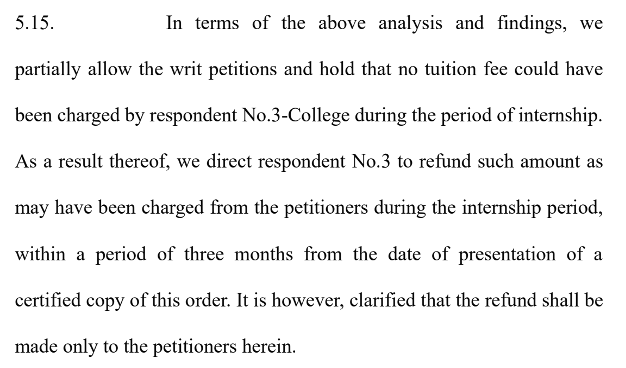
In Akin Saroya & Others vs. State of Punjab & Others, the court has held that private unaided veterinary colleges cannot charge tuition fees during the compulsory internship period of the B.V.Sc. & A.H. course, and directed the refund of such fees collected from students.
The ruling came in a batch of writ petitions filed by veterinary students who had completed academic coursework and were undergoing mandatory internships under the Veterinary Council of India (VCI) regulations. The students challenged the practice of a private affiliated college charging tuition fees during internship, while paying only a nominal internship allowance.
The Court examined the VCI’s Minimum Standards of Veterinary Education Regulations, which mandate payment of internship allowance and recognise interns as full-time professionals performing veterinary duties under provisional registration, including night and emergency work. It noted that interns are barred from other employment and receive no classroom teaching during this period.
The Court held that charging tuition fees during an internship effectively nullified the statutory requirement of paying an internship allowance and amounted to indirect exploitation. While acknowledging the autonomy of private unaided institutions in fixing fees, it held that such autonomy does not extend to profiteering or practices that defeat regulatory intent.
Significantly, the Court noted that the affiliating university did not charge tuition fees during the internship, and that the respondent college itself had discontinued the practice in later academic years, indicating recognition of its impermissibility.
On the issue of internship allowance, the Court declined to fix or enhance rates, observing that no uniform statutory framework exists and policy decisions must be left to competent authorities.
The petitions were partly allowed, and the respondent college was directed to refund all tuition fees collected from the petitioners for the internship period within three months.

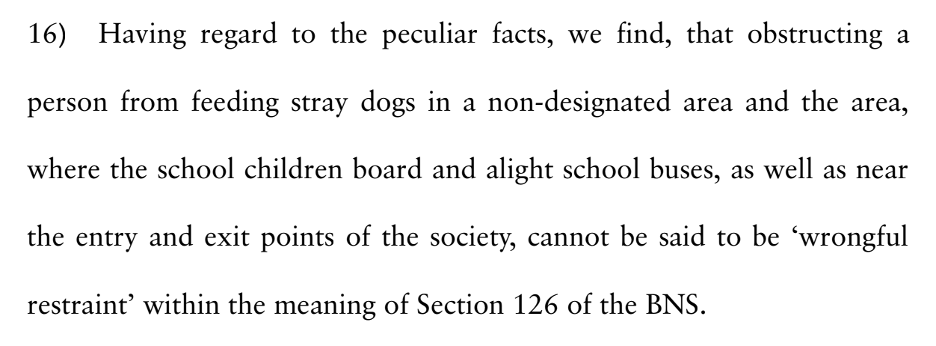
Bombay HC: Preventing feeding stray dogs near school bus stops not a criminal offence
In Ayyappa Swami vs. State of Maharashtra, the Bombay High Court has quashed an FIR and criminal proceedings against a Pune resident accused of wrongful restraint and criminal intimidation during a dispute over feeding stray dogs in a gated society.
The FIR alleged that the applicant obstructed a woman from feeding stray dogs near society premises, attempted to snatch her phone while she was recording the incident, and blocked her car. Charges were registered under Sections 126(2) and 351(1)–(2) of the Bharatiya Nyaya Sanhita, 2023.
The applicant argued that the FIR was a counterblast to his earlier complaints and that residents had objected to feeding dogs near entry–exit points and a school bus stop due to repeated dog-bite incidents. He contended that preventing feeding in sensitive areas for safety reasons could not amount to wrongful restraint.
After examining the FIR, chargesheet, and witness statements, the Court held that the essential ingredients of wrongful restraint were not made out. The court observed that stopping the feeding of stray dogs in non-designated areas, particularly near school bus points and society entrances, could not be treated as illegal obstruction. The allegation of blocking the complainant’s car was found vague and unsupported.
Relying on the statutory exception to Section 126 and Supreme Court observations on risks posed by unregulated stray dog feeding, the Court held that actions taken in good faith to protect safety do not constitute an offence. The Bench also noted a four-month delay in lodging the FIR and the existence of prior complaints by the applicant.
Holding the proceedings to be an abuse of process, the High Court quashed the FIR and all consequential proceedings.