These links sent via SMS and WhatsApp asking for payment of pending traffic challan are fake and fraudulent
Traffic challan links (here, here, here, and here) are being circulated on instant messaging platforms such as WhatsApp and through SMS. These messages appear like official traffic police notifications and claim that a traffic fine is pending, prompting recipients to click a link to make the payment. We have received several queries on our WhatsApp tipline (+91 92470 52470) seeking clarification on whether these links are genuine. Let’s verify the claim made in the post in this article.


Claim: Pending traffic challan payment websites shared via SMS and WhatsApp are official portals for paying traffic fines.
Fact: These links are not genuine and are meant to scam users. Cyber fraudsters send fake e-challan messages that mimic official traffic police notifications, directing victims to fraudulent websites that steal card details, OTPs, or personal information, and payment leading to financial losses. Police have advised citizens to verify challans only through the official Parivahan e-Challan portal or State Traffic Police websites and to avoid clicking payment links in messages. Hence, the claim made in the post is FALSE.
To verify the link, we opened it and entered a random, invalid vehicle number (ABCD) before clicking the ‘Get details’ option. The page surprisingly showed that a challan of ₹500 was pending for speeding, even though this is not a valid vehicle number. We then tried several other random combinations of letters and numbers, and each time the link displayed the same ₹500 fine, indicating that the link was not genuine. An important notice on the page stated that failure to pay the fine by the due date could lead to additional hefty fines, suspension of the driving licence, court summons, legal proceedings, and vehicle impoundment in severe cases.


We noticed that the URL of the link does not contain “.gov”, which is typically present in official government websites. We compared it with the Telangana government’s official e-challan website and the Centre’s Parivahan e-challan portal, both of which have “.gov” in their web addresses. This feature is missing in the viral links, confirming that they are fake.


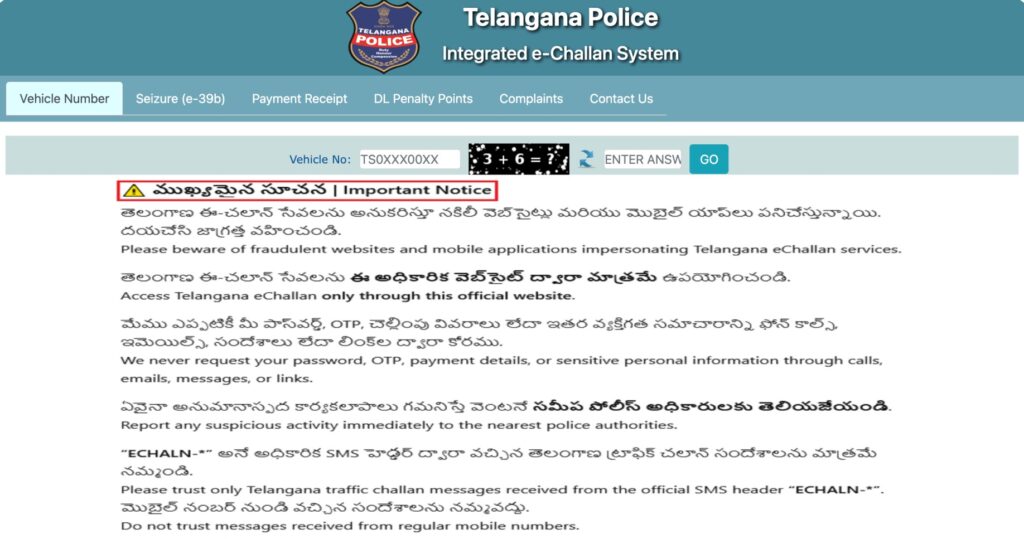
We also noticed that the Telangana government’s official e-challan website has a notice stating that fraudulent websites and mobile applications are operating by impersonating Telangana eChallan services, and users should be cautious. It emphasises that Telangana eChallan services should be accessed only through the official website. The notice clarifies that authorities never request passwords, OTPs, payment details, or other personal information through phone calls, emails, messages, or links. It also advises reporting any suspicious activity immediately to the nearest police authorities and instructs users to trust only Telangana traffic challan messages received from the official SMS header “ECHALN-*”, while messages from regular mobile numbers should not be trusted.

Several media reports (here, here and here) have highlighted that cyber fraudsters are targeting motorists with fake e-challan messages mimicking official traffic police notifications, causing significant financial losses. Victims receive SMS or WhatsApp messages claiming pending traffic fines, often with links resembling official portals. Clicking these links redirects users to fake websites that steal card details, OTPs, or personal information, leading to unauthorised transactions and losses of lakhs of rupees. Authorities advise verifying challan details only through the official Parivahan e-Challan portal or respective State Traffic Police websites and never clicking payment links from messages.


Hyderabad Police, Bangalore Police, and Delhi Police have warned citizens to be cautious of fake traffic challan messages containing links that may carry malware.
To sum up, these pending traffic challan links sent via SMS and WhatsApp are fake and fraudulent.