Meat Production Rises 29% in India, But Five States Drive Most of the Supply
TL;DR India’s meat production has increased by 29% to 10.50 million tonnes in 2024-25, with the poultry sector contributing nearly half of this total. Production is geographically uneven, as five states account for over 57% of the national supply. While specific regions dominate certain categories, such as Uttar Pradesh for buffalo and southern states for sheep, production levels do not always align with local demand.
Context
Meat production in India has been in the news recently due to price fluctuations, export developments, and changing consumption patterns. The sector, which includes poultry, buffalo, goat, and sheep meat, continues to grow steadily as demand from both domestic and international markets increases. At the same time, discussions around food choices, nutrition, and sustainability are influencing how the industry is viewed and regulated. In this story, we examine the latest data on meat production in India, highlighting key trends across different categories and regions.
Who compiles this data?
The data comes from the Department of Animal Husbandry and Dairying (DAHD) under the Ministry of Fisheries, Animal Husbandry and Dairying. Its Animal Husbandry Statistics Division runs the Integrated Sample Survey (ISS) every year in rural and urban areas across all states and Union Territories to estimate the production of milk, eggs, meat and wool.
Where can I download clean & structured data related to meat production in India?
Clean, structured, and ready-to-use datasets related to the meat production, per capita availability of meat, meat production by different types and many more can be downloaded from Dataful.
Key Insights
- India ranks 4th in the world in terms of total Meat production, according to FAO. The total meat production in the country reached 10.50 million tonnes during 2024-25, marking a significant 29% increase from 8.11 million tonnes in 2018-19.
- Poultry remains the dominant category, accounting for nearly half of India’s total meat output and recording a 16% growth over the last five years.
- The small ruminant sector recorded the fastest relative growth, with sheep and goat meat production increasing by 35% and 30% respectively, over the last five years.
- Production is highly concentrated. Just five states, namely, West Bengal, Uttar Pradesh, Maharashtra, Andhra Pradesh, and Telangana, account for more than 57% of India’s total meat production.
- Uttar Pradesh firmly holds its position as India’s leading producer of buffalo meat, contributing close to 39% of the national output, or about 760 thousand tonnes. Its production volume is over three times higher than that of Maharashtra, which ranks second.
- West Bengal accounts for nearly 31% of India’s total goat meat supply, while sheep meat production is largely concentrated in the southern region. Andhra Pradesh and Telangana together account for about two-thirds of the national output.
- Kerala continues to be the main centre for cattle meat production in India, but the sector has seen a decline of 34% in the last four years.
- While Telangana records a per capita meat availability of nearly 29 kg, almost four times the national average, states like Gujarat and Himachal Pradesh remain below 1 kg.
- Comparing supply data with NFHS consumption trends reveals that high availability does not always reflect local dietary habits. For instance, while Haryana ranks second in production availability, its low consumption rates suggest it functions primarily as a supply hub for other regions rather than for local consumption. In contrast, southern states like Telangana and Andhra Pradesh show a strong alignment, leading the country in both per capita availability and actual dietary demand.
Why does it matter?
The meat sector is a critical pillar of India’s agricultural economy, essential for both food security and rural livelihoods. However, the latest data exposes a widening gap between production hubs and consumption centres. While national output is surging, production is increasingly centralised in just a few states, creating logistical challenges and highlighting a disconnect between where food is grown and where it is eaten. Understanding these trends is vital for addressing supply chain inefficiencies and ensuring price stability for consumers.
Key Numbers
- Total Meat Production (in million tonnes)
8.11 (2018-19) → 10.50 (2024-25)
5 states account for 57% production
- Poultry Production (in million tonnes)
4.47 (2020-21) → 5.18 (2024-25)
- Highest Per Capita Meat Availability (kg/annum)
Telangana: 28.8
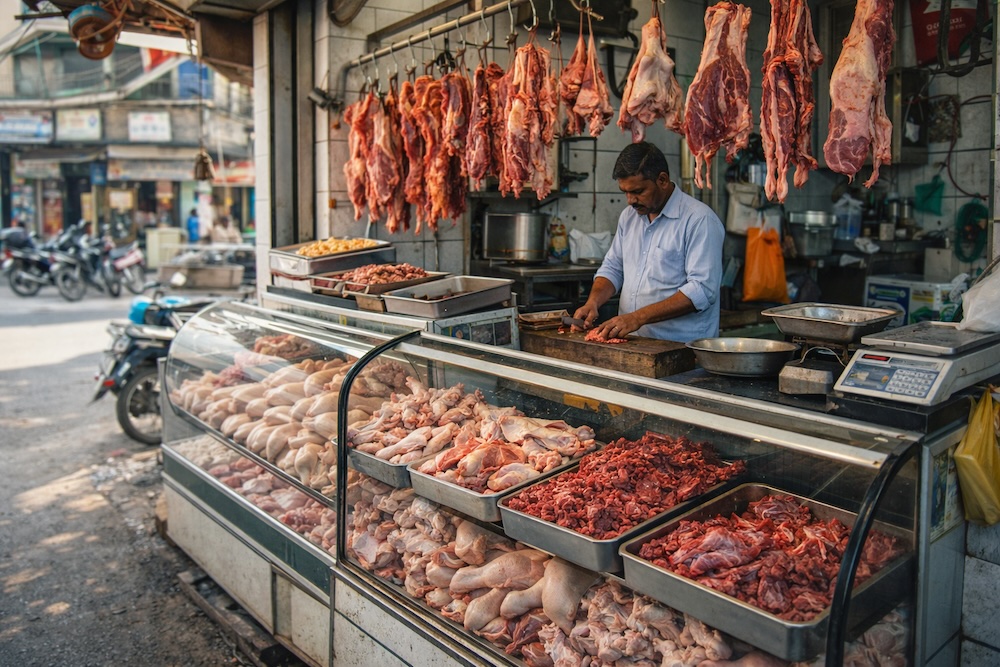
Note: Featured Image generated with ChatGPT