How New Labour Codes Will Change Gratuity and Strikes in India
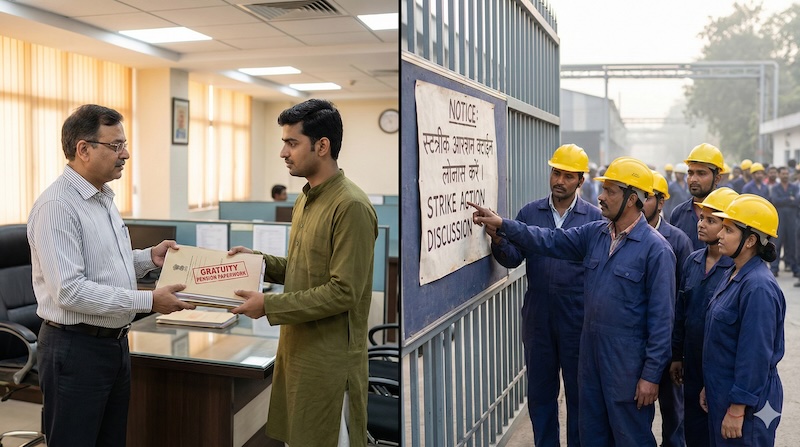
TL; DR: India’s new labour codes reshape work rules- from gratuity eligibility after one year for fixed-term workers to stricter strike procedures requiring 14-day notice in all sectors. While wage definitions will boost retirement and gratuity payouts, constraints on industrial action could make disputes less visible, not less frequent.
Context: On 21 November 2025, the government of India officially notified the four consolidated labour codes replacing 29 earlier central labour laws, namely Code on Wages, 2019, Industrial Relations Code, 2020, Code on Social Security, 2020, and Occupational Safety, Health and Working Conditions Code, 2020. This is in line with the recommendations of the Second National Commission on Labour, 2002.
These changes are aimed at ensuring that fixed-term employees receive the same benefits as permanent staff, including equal wages and gratuity after one year. For the first time, gig and platform workers are legally recognised, with aggregators required to contribute to their social security. Workplace health and safety are strengthened through mandatory annual check-ups, and gender equality is reinforced by prohibiting discrimination, ensuring equal pay, and allowing women to work in all sectors and on night shifts with safety measures.
One of the most widely debated provisions in the new labour reforms is the eligibility of fixed-term employees to receive gratuity after just one year of service. Importantly, this change does not affect the five-year requirement for permanent employees, which remains unchanged. Since comprehensive data on gratuity disbursements by private employers is not publicly available, our analysis will instead focus on trends in gratuity payments to government employees.
Who compiles this data?
The data on the expenditure incurred on pensions and other retirement benefits, including the gratuity, leave encashment, superannuation and so on, is maintained by the Ministry of Finance, and the data on Industrial Disputes is compiled by the Labour Bureau.
Where can I download clean & structured data about Gratuity payments and Industrial Disputes data?
Clean, structured, and ready-to-use datasets on the expenditure on pensions and other retirement benefits, including gratuity and pensions and Industrial Disputes in public and private sectors and across central and state jurisdictions can be downloaded from Dataful.
Key Insights
Government employees received about ₹43K crore in gratuity in last decade
A key feature of the new labour reforms is the revised treatment of gratuity. Under the updated code, fixed-term workers become eligible for gratuity after completing one year of service, while the existing five-year eligibility for permanent employees remains unchanged. This shift acknowledges the rise of short-term and project-based employment and extends retirement benefits to workers who change jobs more frequently.
Government expenditure data highlights the financial significance of this benefit. Between 2014–15 and 2023–24, the Central Government paid over ₹43,000 crore in gratuity, accounting for about 10% of all spending on Pensions and Other Retirement Benefits. This amount is expected to grow under the new labour codes due to a broader definition of ‘wages’. With at least half of total compensation now included in the wage calculation, gratuity will be based on a larger salary share rather than just basic pay, subject to a maximum ceiling of 20 Lakhs. Although the formula for calculating gratuity remains the same, many employees may see a significant rise in their payouts. This could also prompt the employers to restructure the salary components.
Strikes now require advance notice for all workers, not just in Public Utilities
A major change in the Industrial Relations Code now requires workers in every sector to give a 14-day notice before going on strike. Earlier, this rule applied only to essential services like electricity or water supply. Today, even workers in a private factory must follow the same rules. Once a notice is given, negotiations begin under government supervision, and workers are barred from striking until those talks end. In practice, this can delay a strike for months or even stop it altogether.
This change comes at a time when industrial disputes are already falling sharply. By September 2023, only about 30 strikes and lockouts were recorded, the lowest in nearly twenty years. In the mid-2000s, the number regularly crossed 400. The private sector still dominates these disputes, and most conflicts continue to revolve around wages, suggesting that salary disagreements persist even if fewer protests are visible.
With mandatory notice and prolonged conciliation, strikes may become rarer not because conflicts are resolved, but because workers will find it harder to protest.
Why does it matter?
The implementation of the four labour codes potentially reshapes how work, wages, welfare and workplace safety are regulated. The new codes attempt to align labour law with current realities, rather than outdated structures.
At the same time, the flexibility and structural changes especially around employment type, layoffs, collective bargaining rights, and long-term worker welfare, spark serious debates. Real labour reform must protect workers’ earnings and their ability to speak up when those rights are violated.
Key Numbers
- Expenditure incurred on Gratuity by the Union Government
2011-12: ₹ 2138 Crores ; 2018-19: ₹ 4235 Crores ; 2023-24: ₹ 6386 Crores
- Industrial Disputes over the years
2006 Strikes: 243; Lockouts: 187
2015 Strikes: 119; Lockouts: 31
2023(Jan to Sep) Strikes: 29 ; Lockouts: 1